
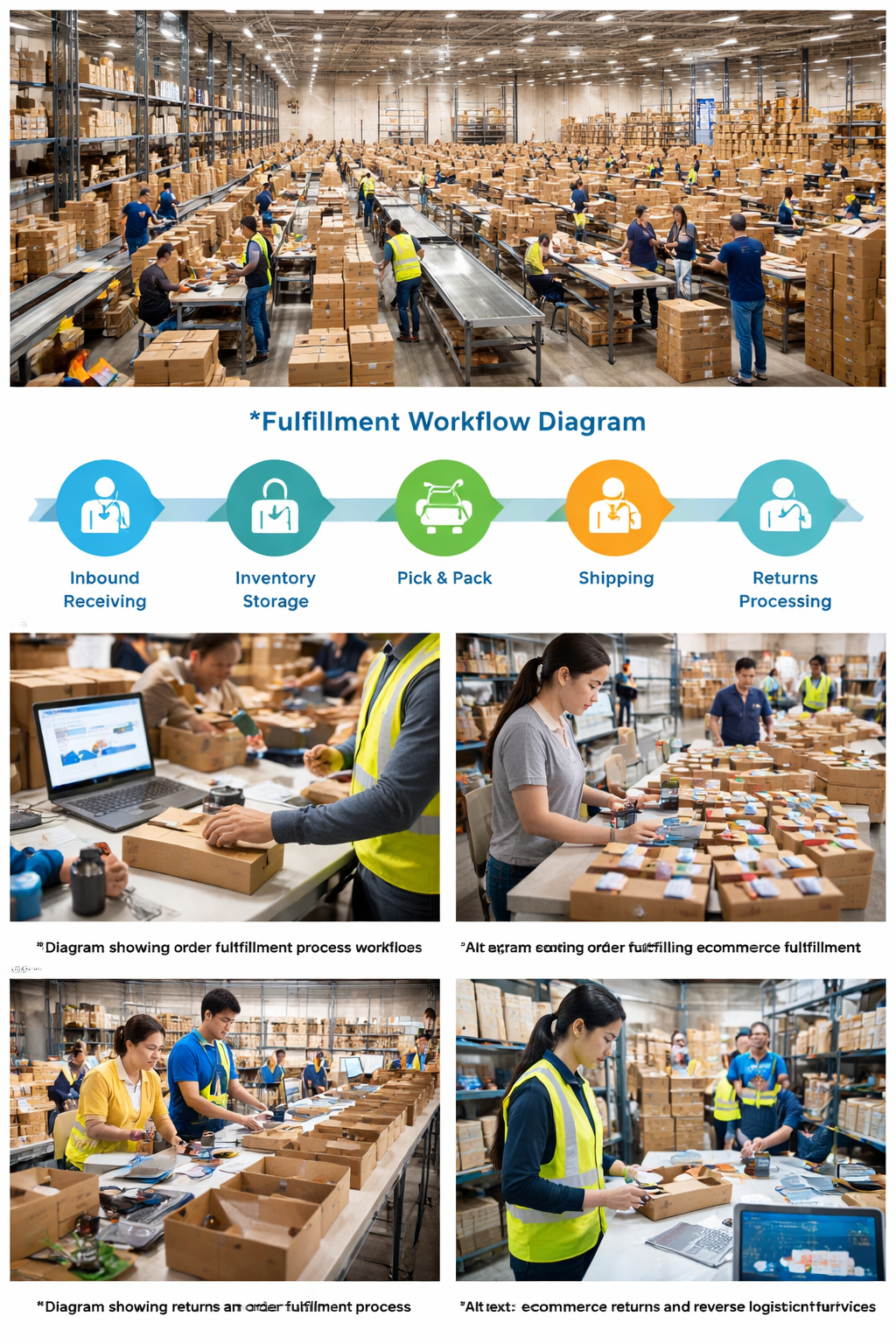
Ecommerce fulfillment services play a critical role in how products move from inventory to the end customer. At Crossdock.Miami, fulfillment is approached as an operational process—focused on accuracy, speed, and consistency—rather than a one-size-fits-all solution.
Brands, importers, and distributors use fulfillment services to streamline receiving, order processing, packing, and outbound shipping while maintaining visibility and control over inventory. This approach allows companies to scale order volume without increasing internal overhead.
What Ecommerce Fulfillment Covers
Ecommerce fulfillment typically includes multiple operational stages that work together to support both direct-to-consumer and business-to-business order flows. Each step is designed to reduce handling time, minimize errors, and keep orders moving without disruption.
Inbound Receiving & Inventory Check-In
Products are received in cartons or pallets, verified against documentation, and prepared for storage, cross-docking, or immediate outbound processing. Accurate receiving is the foundation of reliable fulfillment.
Inventory Storage & Organization
Inventory is stored in an organized and accessible layout that supports efficient picking and replenishment. Proper slotting and labeling help prevent delays and inventory discrepancies as order volume grows.
Order Picking & Packing
Orders are picked based on defined workflows and packed to meet carrier requirements and product protection standards. Fulfillment operations may support single-SKU orders, multi-line orders, and customized packing instructions.
Kitting, Bundling & Light Assembly
Fulfillment services often include kitting and bundling, allowing multiple items to be combined into a single unit. This supports promotional offers, subscription programs, and pre-assembled product configurations.
Shipping Preparation & Dispatch
Orders are labeled, staged, and dispatched for carrier pickup. Efficient shipping preparation helps reduce transit delays and supports consistent delivery performance.
Returns & Reverse Logistics
Returned items can be inspected, sorted, restocked, or isolated according to predefined rules. A structured reverse logistics process helps protect inventory accuracy and recover value.
Order Fulfillment as Part of a Larger Logistics Flow
Fulfillment does not operate in isolation. For many companies, order fulfillment is closely connected to freight forwarding, cross-docking, warehousing, and ongoing distribution activities.
Organizations seeking a full view of professional order fulfillment operations can reference order fulfillment services provided by International 3PL, where fulfillment is integrated with broader transportation and logistics management.
Scalable Fulfillment for Growing Ecommerce Operations
As ecommerce businesses grow, fulfillment requirements often become more complex. Increased SKUs, higher order frequency, and multi-channel sales demand systems that can adapt without disrupting operations.
Technology-driven fulfillment models, including micro-fulfillment strategies, are increasingly used to support faster order processing and regional distribution. Platforms such as MicroFulfillment.ai focus on modern fulfillment frameworks designed for scalability and efficiency in high-volume ecommerce environments.
Who Uses Ecommerce Fulfillment Services
- Direct-to-consumer ecommerce brands
- Importers and distributors managing regional inventory
- Subscription and recurring shipment programs
- Wholesale and retail replenishment operations
- Businesses combining cross-docking with fulfillment workflows
Why Companies Outsource Fulfillment
- Improved order accuracy and consistency
- Faster processing without internal staffing expansion
- Operational focus on sales and product development
- Ability to scale during seasonal or promotional spikes
- Reduced complexity in inventory and shipping management
Fulfillment Built for Operational Efficiency
Ecommerce fulfillment services are most effective when they align with a company’s broader logistics strategy. By focusing on structured workflows, accurate handling, and scalable processes, fulfillment becomes a competitive advantage rather than a bottleneck.
Crossdock.Miami supports fulfillment as part of an integrated logistics environment—connecting inbound movement, order processing, and outbound distribution into a single operational flow.
A: Ecommerce fulfillment services include receiving inventory, storing products, picking and packing orders, preparing shipments, and managing returns for online and wholesale sales channels.
Q: Is order fulfillment only for ecommerce brands?
A: No. Fulfillment is used by ecommerce brands, distributors, importers, subscription programs, and wholesale operations that require structured order processing.
Q: How does fulfillment connect to logistics services?
A: Fulfillment often works alongside freight forwarding, cross-docking, warehousing, and distribution to support end-to-end supply chain operations.
Q: Can fulfillment scale as order volume increases?
A: Yes. Professional fulfillment services are designed to handle increased volume, additional SKUs, and seasonal demand without disrupting operations.